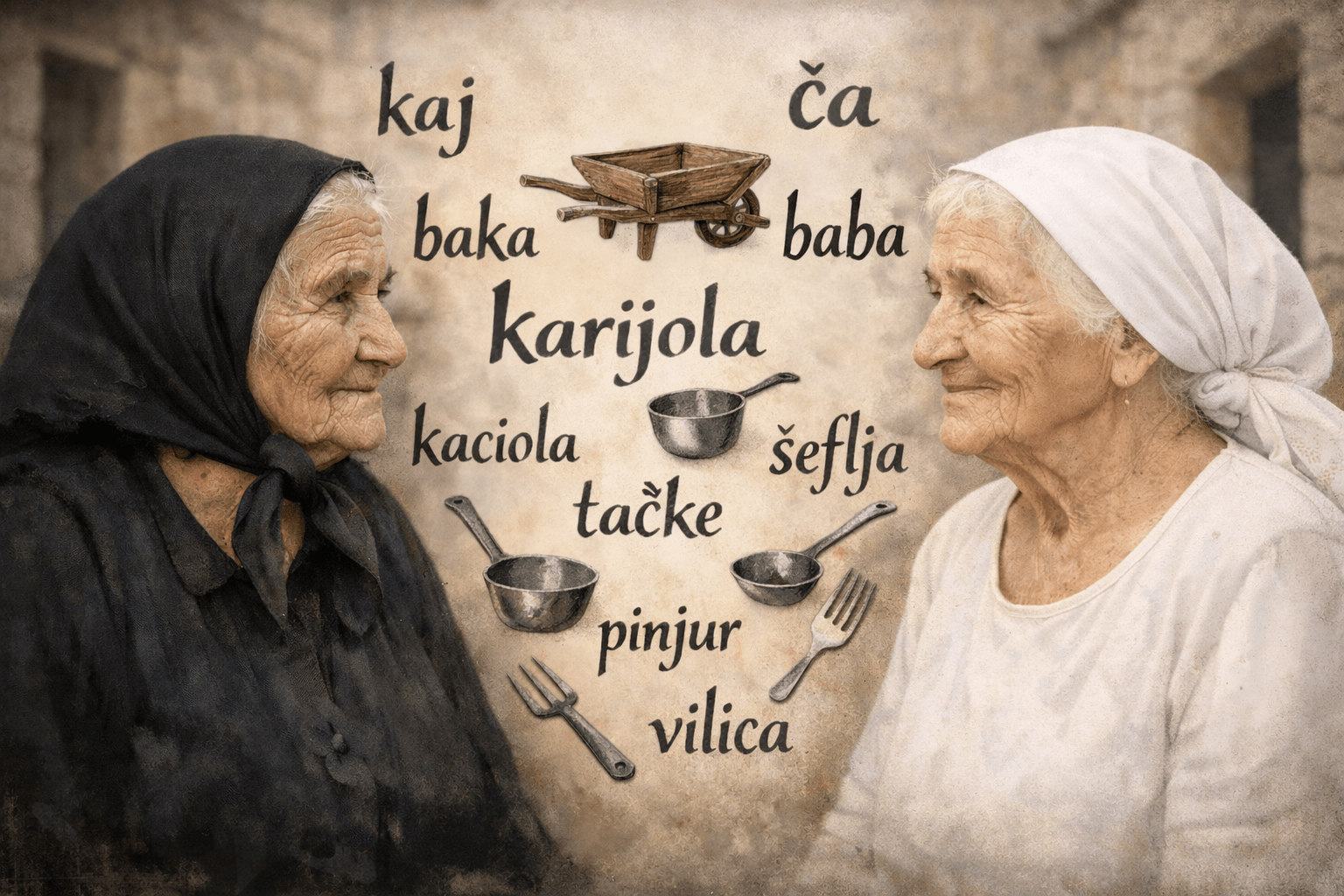
When my two grandmothers, talked to each other, I would often need to translate for them, as they spoke very different dialects. I have always been good at translating, as it was a skill I needed to be able to survive in the family in which two very different worldviews met. Two very different traditions and cultures run in my ancestral lines – paternal from Dalmatinska zagora and maternal line from Hrvatsko zagorje.
The role of the translator is the one I still inhabit at many levels. For example, I literally can sense when one person does not understand what the other person is saying in the language they both speak, and then I translate it to them. I also translate between many different languages that I speak: the language of human rights, the language of spirituality, the language of personal growth. While I am very good at each of them, I have never achieved the level of proficiency (purity) that would clearly signify my belonging to a certain narrative, which would help me be identified as an insider. On the contrary, I have mostly been seen as an outsider in the circles I am inhabiting and have experienced denials of my belonging. For example, the authorities in Croatian legal academia have denied that what I do belongs to legal sciences. In spiritual circles, I have been told I raise too many socio-political issues, while for many human rights activists, I bring in too much spiritual stuff. Even my feminist grounding has been questioned when I started doing research on sex work/prostitution, one of the most divisive topics for feminists.
In the UK, where I did my PhD, my academic work was considered a bit too traditional, in Croatia a bit too avant-garde. In the gatherings with Pascua Yaqui Indians in Arizona, I was considered (too much of a) White European, while in Western Europe, I, as a Croatian, am generally considered Eastern (not in the same way white). In the foreign countries I have lived I was a foreigner even though I felt more at home (in certain aspects) that in Croatia, while in Croatia I have never been enough “ours” (or “theirs”) – not left enough, not right enough. Sometimes, due to this, I forget where my center is. And sometimes, in trying to understand all the different narratives, I neglect developing further my own language. Authentic, unique language of my soul. Sometimes, the wound of the denial of belonging hurts so much that I forget that I do belong to life, purely by the fact that I am here, alive.
